What is HRV: and what it actually tells you as a HYROX athlete
Heart rate variability is the most misunderstood number on your wearable. Not because the science is complicated. Because nobody explains what the number is actually measuring, and what you should do differently based on it.
My first week with a wearable, I spent more time trying to understand my HRV number than actually training.
- Was that good? My training partner was at 72. A guy in my HYROX club posts 110s. I was eating well, sleeping 8 hours, training consistently, and still convinced I was reading the number wrong. Then someone told me they hit 120 during deep sleep. I’d seen peaks above 100 on my own device at night, which made the morning average feel even more confusing.
Nothing was wrong. I just didn’t understand what the number was measuring. Three years later, 90 tells me more than 110 ever told him, because I know what my 90 means. That’s the whole point.
HRV (heart rate variability) is the most cited and least understood number on your wearable: Garmin, WHOOP, Apple Watch, take your pick. Not because the science is opaque, but because the question “what is it?” isn’t the right one. The real question is: what does this number tell me that I don’t already know? And more importantly: what do I do differently because of it?
What HRV actually measures
Your heart doesn’t beat like a clock. Between two consecutive beats, the interval varies, sometimes by a few milliseconds, sometimes more. HRV measures this variation: how much those gaps fluctuate from one beat to the next. That measure is called RMSSD, your variability score. The higher the score, the more your heart is varying its rhythm. And counter-intuitively, that’s a good thing.
Imagine two teams pulling on a rope inside your chest, all day, every day.
Team one is your activation system (the sympathetic nervous system): adrenaline, cortisol, the “go” signal. It pulls the rope toward effort, alertness, activation. Your heart beats faster. You’re ready to run, lift, or respond.
Team two is your recovery system (the parasympathetic nervous system): the vagus nerve, calm, repair. It pulls back. Heart slows. Digestion restarts. The body shifts into repair mode.
Your HRV is the score of that tug-of-war, measured millisecond by millisecond between heartbeats. When both teams are strong and pulling against each other, your heart oscillates: a bit faster on every inhale (your activation system nudging the pace up), a bit slower on every exhale (your recovery system pulling it back). That push-pull is what creates variability.
Your HRV is not comparable to your training partner’s
This is the first mistake athletes make when they discover HRV. They look for a “good number.” There isn’t one.
The normal range between healthy individuals spans from a variability score of roughly 20 to over 120. That range isn’t a reflection of fitness or health. It’s partly anatomy. How strongly the recovery signal reaches your heart varies person to person, for reasons unrelated to training level.
Most wearables (Garmin, WHOOP, Apple Watch) calculate your baseline over a rolling 2–4 week window. Deviations from your own baseline are the signal. A deviation beyond your personal tolerance zone matters more than the absolute number. My 61 tells me more than your 110 tells you, if you don't know what your 110 means.
My baseline sits at around 61 ms (lnRMSSD: 4.10, measured on the Elite HRV morning protocol), with a personal tolerance zone of ±15 ms, giving a normal range of 46 to 76. During active training weeks, my score drifts toward the lower edge of that range. On weeks without structured training, it climbs back toward the top. That gap is what the training load costs your nervous system. Below 46, I pay attention.
What actually moves your HRV, and in what order it matters
Some levers shift HRV dramatically. Others barely register. In rough order of magnitude:
Alcohol. The most brutal lever. A single evening with 2-3 drinks measurably suppresses your overnight variability score for 24-48 hours in most athletes. The effect is dose-dependent and consistent across individuals. It is one of the few HRV variables where comparison between people holds up.
Sleep: quantity and quality. Nocturnal HRV is measured during sleep because that’s when your nervous system recovers without conscious interference. A sleep deficit, prolonged night waking, or poor slow-wave sleep quality depresses the following morning’s variability score.
Late meals. Eating within 2-3 hours of sleep keeps your digestive system active through the night, maintaining partial activation in your nervous system. Data from Whoop shows a measurable drop in your overnight variability score for meals taken less than 2 hours before bed.
Acute training load. After an intense session, your HRV drops. Expected and normal. The useful signal isn’t the drop itself, it’s the speed at which you return to baseline. Slow recovery over 48-72 hours post-session can indicate accumulated residual fatigue.
Hydration. Dehydration reduces circulating blood volume, raises resting heart rate, and mechanically compresses variability. Simple, and frequently overlooked.
Two different numbers tell two different things, and mixing them up is the second most common mistake after comparing yourself to others.
The nocturnal HRV (the average Garmin calculates across your full sleep window) tells you how well you recovered during the night. My baseline sits around 61 ms. During a hard training week it drifts toward the lower edge of my tolerance zone, around 46 ms. On rest weeks it climbs back toward the upper edge, around 76 ms.
The morning lying-down test (a 2-minute measurement taken immediately after waking) tells you something different: whether your nervous system is ready for today. That number is higher. Mine reads 144 ms the morning after a normal recovery night. The gap between your nocturnal average and your morning test is not a contradiction. It reflects the difference between “how did you recover” and “what can you do now.”
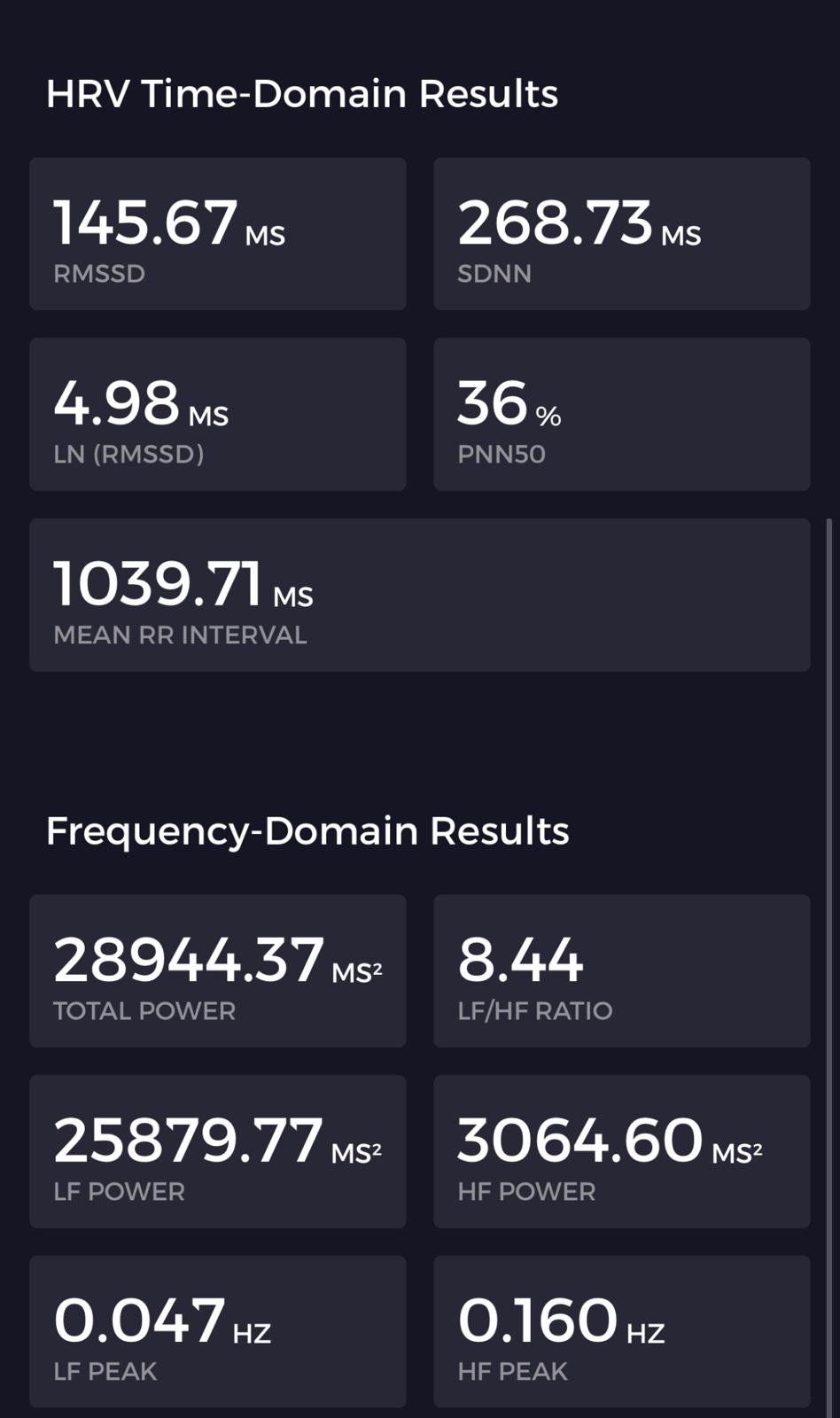 Morning readiness test using a Garmin chest strap paired with the Elite HRV app, measured lying down right after waking. Variability score: 145 ms, almost identical to the watch reading from the same morning (144 ms). Two different devices measuring the same thing, agreeing on the number.
For me, training load shows up most clearly in the nocturnal average. That is the number I track across weeks to understand what the work is costing.
Using your HRV to make decisions, not just to observe
The meta-analysis by Düking et al. (2021) reviewed 8 studies on 198 athletes, comparing HRV-guided training (adjusting daily intensity based on your morning variability score) against fixed training plans. HRV-guided athletes had fewer non-responders (athletes who train hard but don’t improve) and showed a measurable advantage on submaximal performance parameters.
The performance gain isn’t dramatic. But that’s the wrong metric to look for. The real gain is avoiding high-intensity sessions on days when your body isn’t ready to absorb them, reducing the risk of overreaching and residual fatigue accumulation across loaded training blocks.
In practical terms:
Nocturnal HRV below your Garmin baseline → worth paying attention to. Not an automatic cancellation, but a signal to look at the full picture: yesterday’s RPE, your muscular sensations, your sleep score, and how you feel standing up.
Nocturnal HRV within or above your baseline → proceed with planned intensity.
My signal threshold is when my reading drops below 46 ms (baseline of 61 minus the tolerance zone of 15 ms). That is when I consider changing the programme, not cancelling it. A low HRV doesn’t mean no training. It means no that training. The high-intensity session gets rescheduled, replaced with a different stimulus: lower intensity, different movement pattern, shorter duration. The goal is to keep the adaptation process running without compounding the load that already accumulated.
That said, the Garmin reading alone is not enough to make that call with confidence. Here is the core limitation: the nocturnal HRV is a passive measurement taken while you sleep. It tells you the state of your autonomic nervous system at rest. What it does not tell you is how that system responds when you actually challenge it: when you stand up, when you shift from recovery mode to readiness mode. That dynamic response is a different signal, and it is often the one that determines whether a low reading means “back off” or “you are fine, just start easy.”
The orthostatic test (lying down for 5 minutes, then standing for 5 more) captures exactly that response. It is what the next article covers in full.
What HRV doesn’t do
This is where most articles stop. And exactly where the problem starts.
HRV does not predict your performance for the day. A normal or elevated variability score doesn’t guarantee a good session. Neurological fatigue, motivation, cognitive load, glycogen status. None of these show up in your morning score.
HRV does not replace sensations. If your HRV reads green but your legs feel like concrete, the HRV missed something. It happens. Your wearable’s algorithm uses proxies. It captures your variability score during a specific sleep window, not continuously. What it captures is real, but partial.
HRV is not comparable across devices. The variability score calculated by Garmin, Whoop, Apple Watch, or a Polar chest strap will produce different numbers for the same night. Algorithms, measurement windows, and sensors are not standardised. Compare your HRV only with the same device, under the same conditions.
HRV doesn’t necessarily rise with short-term training increases. During a loaded week, you may see your HRV decline progressively. That’s normal fatigue. The trend worth tracking is across several weeks: HRV returning to baseline or above after each recovery cycle is the signal your body is absorbing the training load correctly.
A low HRV is a signal about type of stimulus, not about volume of training. When my variability score drops, I'm not looking to do less. I'm looking to do different. A heavy nervous system doesn't need more stress of the same kind: it needs a different stimulus that keeps adaptation running without adding to the load that already accumulated.
The mistake most athletes make with a low HRV is binary thinking: green means go, red means rest. That’s not how I use it.
A low HRV is a signal about type of stimulus, not about volume of training. When my variability score drops, I’m not looking to do less. I’m looking to do different. A heavy nervous system doesn’t need more stress of the same kind. It needs a different stimulus that keeps the adaptation signal running without adding to the load that already accumulated.
That reframe changes how you read the number. It’s not a traffic light. It’s information about which gear to drive in today.
A low HRV also doesn’t mean something is wrong. It often means something went right. A hard session landed, the training stress was real, and your body is processing it. That’s the job. The device is just telling you it’s still working.
What this article doesn’t cover, and what comes next
Understanding what HRV measures is step one. The harder problem is knowing what to do with the number you see every morning.
That means reading trends, not snapshots. Knowing when a three-day dip is normal fatigue and when it’s a warning. Understanding what your wearable’s colour-coding actually represents, and where it’s oversimplifying. Building a simple decision framework you can apply in 30 seconds before a session.
That is the subject of the next article: How to read your HRV data: a practical guide for HYROX athletes. It covers the specific numbers, the trends worth watching, the ones worth ignoring, and the orthostatic test protocol that turns a single HRV reading into an actionable decision. I am currently running that protocol with a chest strap and Elite HRV, and I will publish the results once I have enough training blocks to make it worth your time.
Coming soon, published with personal data from the orthostatic protocol testing.
What does my Garmin HRV Status actually mean?
The Garmin HRV Status (the label shown on your Fenix, Epix, or Forerunner) is not your raw variability score. It’s a proprietary classification based on your personal 3-week rolling baseline. “Balanced” means your overnight variability score is within your normal range. “Low” means it’s significantly below. “Elevated” (less common) means it’s above, often seen after a successful recovery week. What the status doesn’t tell you is why. A “Low” reading can come from hard training the day before, poor sleep, the beginning of an infection, or non-physical stress. The HRV catches the signal. Interpreting it is still your job.
Why is my HRV low after a hard training session?
A low HRV the morning after intense training is normal and expected. Your nervous system is recovering. The signal becomes relevant when your HRV stays significantly below your normal range beyond 48–72 hours, especially if the pattern repeats across multiple weeks. That is when you are entering the territory of residual fatigue, where your recovery system is consistently overwhelmed and you need to adjust your training load accordingly.
What’s a good HRV score for a HYROX athlete?
There isn’t one. A healthy athlete can have a variability score of 25 or 100. Both are normal depending on individual physiology. What matters: your HRV is stable and consistent within your personal range during normal training weeks, and it returns to that range after each recovery block. That’s the health signal. Not the absolute number, and definitely not how it compares to the person next to you on the start line.